 Image 1 of 3
 Image 2 of 3
 Image 3 of 3
Black Walnut seedlings from superior parent trees for culinary purposes. The seed for these was collected from all-cultivar grafted orchards, so the chances that they will carry forward their superior traits is high. Black walnuts are known for growing extremely quickly and bearing at a young age. If planted in favorable conditions, you should see nuts in 5-10 years.
What makes a superior parent tree? One which produces nuts which make a thin shell, higher kernel:shell ratio, and which crack out easily for good extraction of kernels in halves and quarters. Selection for nut quality is not the same as selection for timber quality!
The primary parent trees used here:
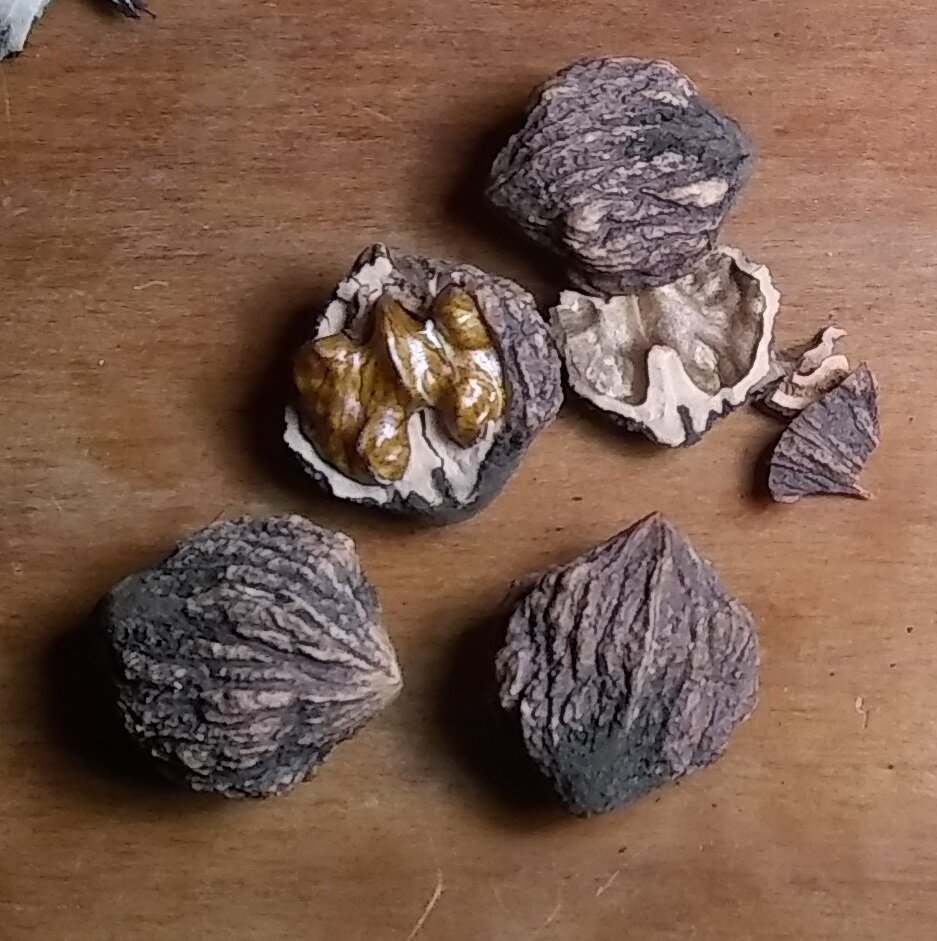
Elmer Myers — has a very thin shell and cracks beautifully for easy extraction. Outside of the nut inside the shell has an appearance like a Holstein cow revealing her hip bones: likewise with the Elmer Myers walnut, there are impressions of the kernel “pushing out” of the corners of the nut. I don’t know if Elmer Myers was a selection from the wild, but I suspect it was grown out by a nut grower from another superior parent tree. Elmer Myers in turn has proven itself to make quality seedlings. For instance, it is the parent for Pounds #2, which has one of the thinnest shells of any black walnut known.
Stabler — an older cultivar of black walnut known for producing “single lobes,” that is, one entire fused nutmeat rather than two separate lobes. Few if any of the seedlings will carry forward this trait, however.
Vandersloot — a wild selection from the banks of the Muddy Creek in York county, Pennsylvania. Makes a very large black walnut which cracks out beautifully.
These 1 year old bareroot seedlings are 3-5’ tall with vigorous root systems!
Black Walnut seedlings from superior parent trees for culinary purposes. The seed for these was collected from all-cultivar grafted orchards, so the chances that they will carry forward their superior traits is high. Black walnuts are known for growing extremely quickly and bearing at a young age. If planted in favorable conditions, you should see nuts in 5-10 years.
What makes a superior parent tree? One which produces nuts which make a thin shell, higher kernel:shell ratio, and which crack out easily for good extraction of kernels in halves and quarters. Selection for nut quality is not the same as selection for timber quality!
The primary parent trees used here:
Elmer Myers — has a very thin shell and cracks beautifully for easy extraction. Outside of the nut inside the shell has an appearance like a Holstein cow revealing her hip bones: likewise with the Elmer Myers walnut, there are impressions of the kernel “pushing out” of the corners of the nut. I don’t know if Elmer Myers was a selection from the wild, but I suspect it was grown out by a nut grower from another superior parent tree. Elmer Myers in turn has proven itself to make quality seedlings. For instance, it is the parent for Pounds #2, which has one of the thinnest shells of any black walnut known.
Stabler — an older cultivar of black walnut known for producing “single lobes,” that is, one entire fused nutmeat rather than two separate lobes. Few if any of the seedlings will carry forward this trait, however.
Vandersloot — a wild selection from the banks of the Muddy Creek in York county, Pennsylvania. Makes a very large black walnut which cracks out beautifully.
These 1 year old bareroot seedlings are 3-5’ tall with vigorous root systems!